|
Lepraria vouauxii (Hue) R.C. Harris |
|
|
|
|
|
Nomenclatural data
|
Harris, in Egan, The Bryologist 90: 163 (1987)
Crocynia vouauxii Hue, Bull. Soc. Bot. France 71: 392 (1924); Leproloma vouauxii (Hue) J.R. Laundon, The Lichenologist 21: 13 (1989)
Crocynia arctica Lynge, Skr. om Svalbard og Ishavet 81: 19 (1940); Lepraria arctica (Lynge) Wetmore, Publs Mich. St. Univ. Mus., biol. ser., 3: 440 (1968)
|
|
Morphology
|
Leprose, usually cottony, soft, thick; white, cream to greyish cream; thallus margin delimited, sublobed or diffuse; medulla absent to prominent, white, usually present; soredia rather loosely packed, mostly coarse, often with short projecting hyphae.
|
|
Chemistry
|
|
The diagnostic substance of this species is pannaric acid 6-methylester, often accompanied by a selection of related dibenzofurans and very rarely atranorin (Elix & Tønsberg 2004). This is also the main pattern in the Greenland chemotypes: (1) with pannaric acid 6-methylester only (n = 44); (2) with pannaric acid 6-methylester and roccellic/angardianic acid (n = 4); (3) with pannaric acid 6-methylester and atranorin (n = 1). Roccellic/angardianic acid as an accessory compound has been reported earlier (Laundon 1989, Leuckert et al. 1995).
|
|
Remarks
|
|
L. vouauxii can be quite variable in its thallus characters but is usually recognizable by its consistence and colour in Greenland. The recently described L. gelida (Tønsberg & Zhurbenko 2006) may resemble this species morphologically and has a similar distribution pattern in Greenland. Still, the pannaric acid 6-methylester content of L. vouauxii makes it distinct from other species.
|
|
Ecology and distribution
|
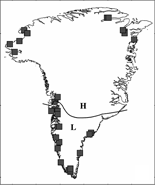
Greenland |
On soil and bryophytes, sometimes overgrowing other lichens, rarely on rocks.
L. vouauxii is common in Greenland, being distributed discontinuously in the south, northeast and northwest of the island.
|
|
|
|
|
|
|
|
