|
Usnea intermedia (A. Massal.) Jatta |
|
|
|
|
|

|
Nomenclatural data
|
Flora Ital. Cryptog. 3: 145 (1909)—Usnea barbata var. intermedia A. Massal., Schedul. Critic. 3: 62 (1856).—Usnea carpatica Motyka, Lich. Gen. Usnea Stud. Monogr., Pars Syst. 2(1): 469 (1937)—Usnea faginea Motyka, Lich. Gen. Usnea Stud. Monogr., Pars Syst. 1: 172 (1936)—Usnea glauca Motyka, Lich. Gen. Usnea Stud. Monogr., Pars Syst. 1: 167 (1936)—U. hapalotera (Harm.) Motyka, Lich. Gen. Usnea Stud. Monogr., Pars Syst. 1: 235 (1936)—Usnea harmandii Motyka, Lich. Gen. Usnea Stud. Monogr., Pars Syst. 1: 163 (1936)—Usnea montana Motyka, Lich. Gen. Usnea Stud. Monogr., Pars Syst. 1: 234 (1936)—Usnea neglecta Motyka, Lich. Gen. Usnea Stud. Monogr., Pars Syst. 1: 179 (1936)—Usnea protea Motyka, Lich. Gen. Usnea Stud. Monogr., Pars Syst. 1: 232 (1936)—Usnea quasirigida Lendemer & I.I. Tav., Proc. Acad. Nat. Sci. Philadelphia 153: 179 (2003).—Usnea rigida Motyka, Lich. Gen. Usnea Stud. Monogr., Pars Syst. 1: 177 (1936), nom. illeg., non Usnea rigida Vainio (1901).—Usnea smaragdina Motyka, Lich. Gen. Usnea Stud. Monogr., Pars Syst. 1: 161 (1936).
|
|
Morphology
|
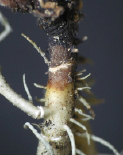
For a detailed description, see Clerc (1984, 2007) and Halonen et al. (1998). Thallus shrubby to pendent; base pale or blackened; branches are irregularly swollen and may have foveoles and depressions on the surface; fibrils numerous; papillae abundant, verrucose or cylindrical; soralia and isidiomorphs absent; apothecia frequent, arising at apices of primary and secondary branches, with long marginal projections; ascospores 7–8.5 μm long. Cortex thin; medulla thin, loose.
|
|
Medullary chemistry
|
Chemotype (1) with salazinic acid (K+ yellow to red, Pd+ orange) as a main substance is known in Europe; chemotype (2) with protocetraric acid (K–, Pd+ orange) as a main substance is known in North America ( Halonen et al. 1998); chemotype (3) without medullary compounds (K–, Pd–) has also been reported from North America ( Clerc 2007). |
|
Remarks
|
|
Differs from another fertile European taxon, U. florida, by subpendent to pendent thallus, medullary chemistry and shorter ascospores (8–11 μm long in U. florida).
|
| Click on images to see more! |
Ecology and distribution
|
 |
Europe (map legend)
Corticolous. Reported in Europe: Austria, Bulgaria, Czech Republic, Germany, Italy, Poland, Slovakia, Slovenia, Spain, Switzerland, Ukraine.
|
|
|
|
|
|
|
|